Research and Plans
Current work on the research project consists mostly of organising and planning. Of course, organising palliative care is about organising something very different from organising research projects. However, when one takes a degree of analytical distance through theoretical abstraction, the relevance of planning across all organisational tasks becomes apparent.
Carrying out a research project is also about organising and planning. That is particularly relevant for EU-funded research projects, where milestones and deliverables have to be set up with deadlines. As NeDiPal is also about organising, it could be useful to reflect on this a little bit from a sociological point of view.
Particularly in outpatient palliative care, organising is typically about managing cases (Büchner et al. 2026), about managing who needs what, when. On a practical, operative level, planning seems to be about what happens at which point in time. And planning is indeed a reaction to the openness and unpredictability of the future. It's a reaction to a structural lack of knowledge, because from the perspective of the current present, the future is unknowable, which generates the need for decisions. As Heinz von Foerster put it:
Nur die Fragen, die im Prinzip unentscheidbar sind, können wir entscheiden.
Only those questions that are, in principle, undecidable are the ones we can decide.
This applies to both research projects and case management, as both are inherently open and unpredictable.
It is a typical feature of organisations that they are built against the flow of time: they treat the future as fixed, as something they can decide upon, while viewing the past as flexible (Baecker 1994: 162). Through decisions, they constitute current futures, which can, however, only be current futures that are always up for future revisions through renewed decisions.
Therefore, planning is not about what we actually do at a certain point in time, but it brings – as described in the organisational theory of Niklas Luhmann (2019) – reflexivity to decision-making.
Eine Planung beschränkt sich, mit anderen Worten, auf die Festlegung von Entscheidungsprämissen für spätere Entscheidungen. Sie strukturiert spätere Entscheidungssituationen mehr oder weniger stark, nimmt aber die konkreten Entscheidungen über die Handlungen nicht vorweg.
With other words, planning is limited to the determination of decision premises for later decisions. It structures subsequent decision situations to a greater or lesser extent, but does not anticipate the concrete decisions about actions.
The plan sets up premises for future decisions, while the plan itself is also a decision. Like all decisions, it is contingent and paradoxical (Luhmann 2009). There are always alternatives to the decision, but for the decision to be the decision, the alternatives are invisible – at least as long as a new decision is made.
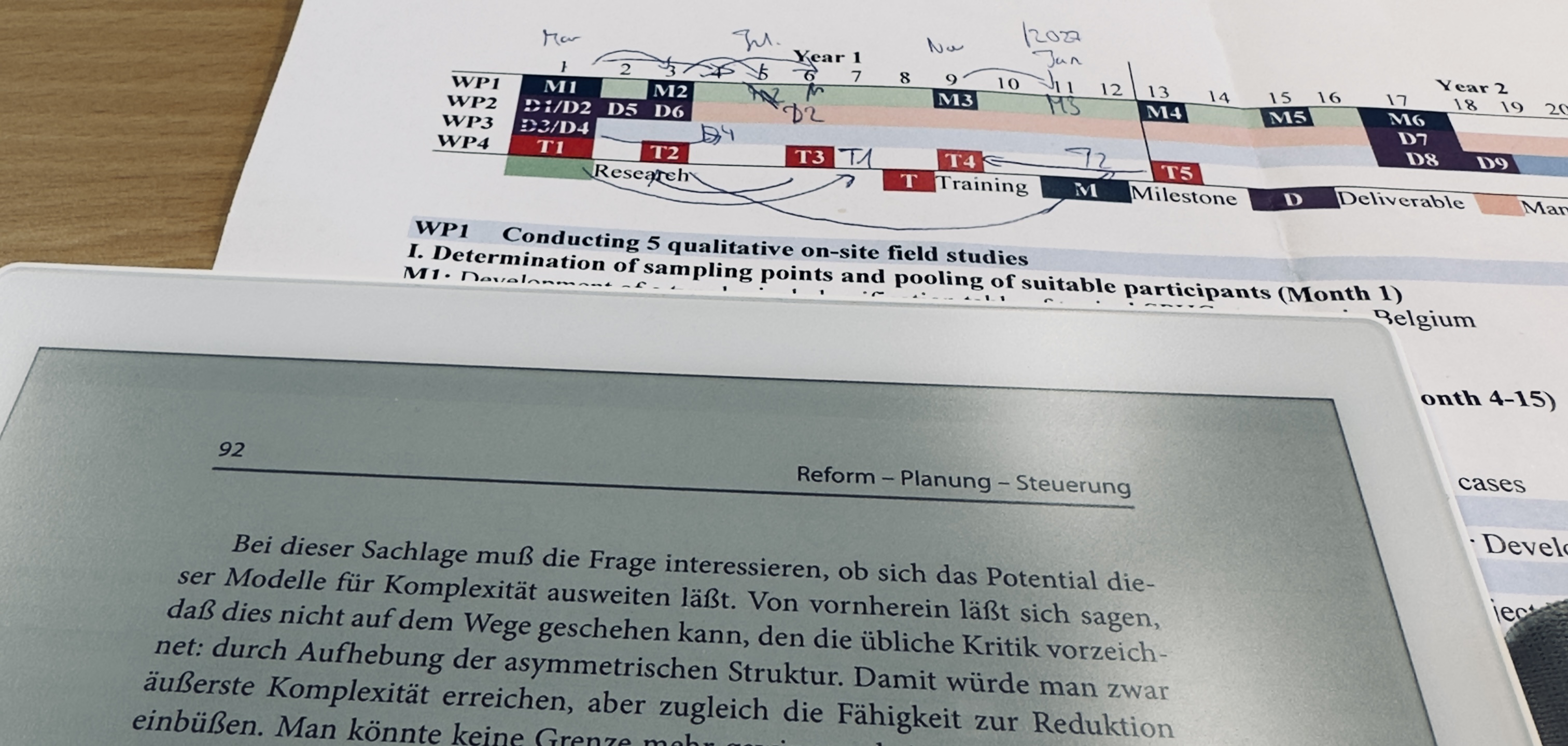
The initial project plan of NeDiPal, the decision of the initial cascade of decisions to be made, has turned out – for various reasons – to be untenable. A decision was made to revise the project plan, thereby changing the premises of future decisions. Whether these changes will be kept is, again, up for renewed decisions. As with all research projects, their outcomes and successes are yet unknown.
The plan is the formal side of the project, from which emerges the optimistic idea that steering into an unpredictable future might be possible (Groddeck 2024: 141). Planning is the relatively inflexible, outward-facing side of the project that gives the project a structure which makes it different from its environment. The project becomes less flexible, more sturdy and stubborn, slower and less adaptable, but therefore distinct from its environment. Through deadlines, the planning creates differences that make the project more resilient to outside interference. It maintains its structure in spite of constant changes in the environment; it adapts its structure to changes in the environment only through decisions and only with regard to certain specific changes.
At the same time, the plan is the side that is specifically geared towards certain environments, which are, for example, in the case of an EU project, the respective project officer, to whom has to report. Here, the plan is the project. But it also cannot be the project, because in order to be workable, the project needs another side that is more flexible but hidden behind the planning. It's the formal side of the project, the side that displays a predictable future. The plan is the project, but the project necessarily is always more than the plan.
References
- Baecker, Dirk (1994). Postheorisches Management. Ein Vademecum. Berlin: Merve.
- Büchner, Stefanie / Braunsmann, Katharina / Gall, Korbinian / Rahn, Justus / Zakharova, Irina (Hg.): Fall und Fallförmigkeit. Organisationen als Kontexte von Fallbearbeitung, Bielefeld: transcript.
- Foerster, Heinz von (2008): KybernEthik. Berlin: Merve.
- Groddeck, Victoria von (2024): Das Ausloten der Manifestierbarkeit der Organisation und das Potential des Latenten: Die historische Veränderung von Steuerungskonzepten in der Managementliteratur, Soziale Systeme, 29(1-2), S. 129-152.
- Luhmann, Niklas (2009): Zur Komplexität von Entscheidungssituationen, Soziale Systeme, 15(1), S. 3-35.
- Luhmann, Niklas (2019): Politische Planung, in: Lukas, Ernst / Tacke, Veronika (Hrsg.): Schriften zur Organisation 4. Reform und Beratung, Wiesbaden: Springer VS, S. 85-118.